
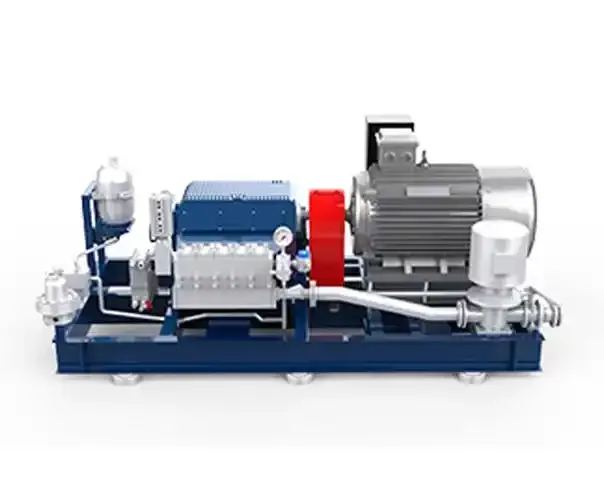
A desalination pump feeds reverse osmosis membranes at stable high pressure and flow—often 24 hours per day in saline environments. Desalination pump selection starts with RO stage duty (seawater SWRO vs brackish BWRO), required feed pressure, corrosion exposure, and whether the unit integrates with energy recovery. This guide covers booster-stage sizing, metallurgy for seawater service, membrane protection, and what to specify before you buy.
What Does a Desalination Pump Do in an RO Plant?
Reverse osmosis removes dissolved salts by forcing feed water through semi-permeable membranes at pressure above osmotic pressure. High-pressure pumps—often multistage centrifugal or reciprocating boosters depending on plant design—deliver that feed stream to the membrane array.
Unlike intermittent oilfield stimulation duty, municipal and offshore desalination plants prioritize stable pressure, low pulsation, and long seal life. Pressure swings stress membrane elements and raise specific energy consumption (kWh per cubic meter). The pump must protect membranes while tolerating chlorides, biofouling risk, and warm intake temperatures in tropical seawater service.
JET desalination pump series targets SWRO booster stages, brackish RO trains, and marine freshwater systems where corrosion-aware high-pressure reciprocating or integrated packages are specified.
SWRO vs BWRO: Different Pressure and Materials
Seawater reverse osmosis (SWRO) typically requires higher feed pressures—often 55–70 bar class depending on salinity, temperature, and recovery—than brackish water RO (BWRO), which may operate at lower pressure with higher recovery ratios.
Material selection diverges accordingly. Seawater wetted parts need duplex stainless, super duplex, or nickel alloys on critical components; brackish plants may use lower grades but still need chloride-aware specs if intake quality varies seasonally.
When comparing quotes, state intake salinity, temperature range, recovery target, and whether feed includes pretreatment backwash or cleaning cycles that change suction conditions.
- SWRO: high pressure, duplex/super-duplex wet ends, offshore or coastal intake
- BWRO: moderate pressure, higher recovery, variable raw water chemistry
- Marine: compact footprint, shock/vibration, redundant feed for platform uptime
Matching Pressure, Flow, and Membrane Protection
Size the booster for design permeate flow plus concentrate recycle and any bypass—not nameplate membrane count alone. Flow shortfall forces membranes to operate off-design; pressure overshoot without control risks element damage.
Pulsation and acceleration head matter on long suction lines to cartridge filters. Reciprocating boosters may need pulsation dampeners and proper suction stabilizers; verify NPSH available at worst-case warm water temperature.
Variable speed drives are common on large trains to track demand and reduce throttling losses. Confirm minimum continuous speed and crank/motor limits if you use reciprocating frames with VFD control.
Corrosion, Seals, and 24/7 Reliability
Seawater attacks standard carbon steel and many seal elastomers. Specify wet-end metallurgy, plunger or shaft coating, and seal flush plan aligned with pretreatment—hypochlorite, acid cleaning, and bisulfite dosing affect compatibility.
Continuous duty demands lubrication systems, oil analysis intervals, and spare kits for valves and seals staged on site or offshore. Mean time between failure on the booster often sets plant availability more than membrane replacement cycles.
Document water quality after pretreatment: SDI, turbidity spikes, and filter changeouts that introduce air or pressure transients to the suction.
Energy Recovery and System Integration
Many modern SWRO plants use energy recovery devices (ERDs) on the concentrate stream. Booster pumps must integrate with ERD hydraulics—sometimes as high-pressure feed pumps and sometimes in hybrid layouts with work-exchange or turbocharger units.
Clarify hydraulic boundary conditions: who owns suction pressure, interstage boost, and startup sequence with ERD isolation. Misaligned controls cause trips during plant ramp.
For greenfield projects, share P&ID-level duty points and redundancy philosophy (N+1 pumps vs single train with spare cartridge) early in RFQ.
Specifying a JET Desalination Pump Package
Bring intake type (open sea vs well), salinity range, design flow and pressure, duty hours, metallurgy standard, and ERD interface to your RFQ. Link requirements to the desalination pump series product line.
Request a quote through the contact page with destination port and commissioning date. Engineering can propose frame size, materials, and driver options before you lock civil and electrical design.
FAQ
What pressure does a seawater desalination pump need?+
SWRO feed pressure depends on salinity, temperature, recovery, and membrane model—typically tens of bar above osmotic pressure, often in the 55–70 bar class for many seawater trains. Provide your membrane vendor design parameters and intake conditions for accurate sizing.
What materials are used for desalination pump wet ends?+
Seawater service commonly uses duplex or super-duplex stainless steels, sometimes nickel alloys on high-wear components. Elastomers and seal flush fluids must match pretreatment chemistry and operating temperature.
Can reciprocating pumps be used for RO booster duty?+
Yes, where compact high-pressure boost or specific integrator packages call for plunger technology. Pulsation control and stable pressure regulation are critical to protect membranes—size dampening and controls accordingly.
Does JET supply desalination pumps for SWRO projects?+
JET builds high-pressure desalination pump packages for SWRO, BWRO, and marine freshwater applications. Share flow, pressure, metallurgy, and redundancy requirements when requesting a proposal.